
Physiomobile Partner Learning
Documentation That Shows Clinical Reasoning
A practical guide to separating reported information, observed findings, interpretation and plan while documenting uncertainty, reassessment and safe follow-up.

AI-generated editorial image; it does not depict actual people, a real clinical record or a patient outcome.
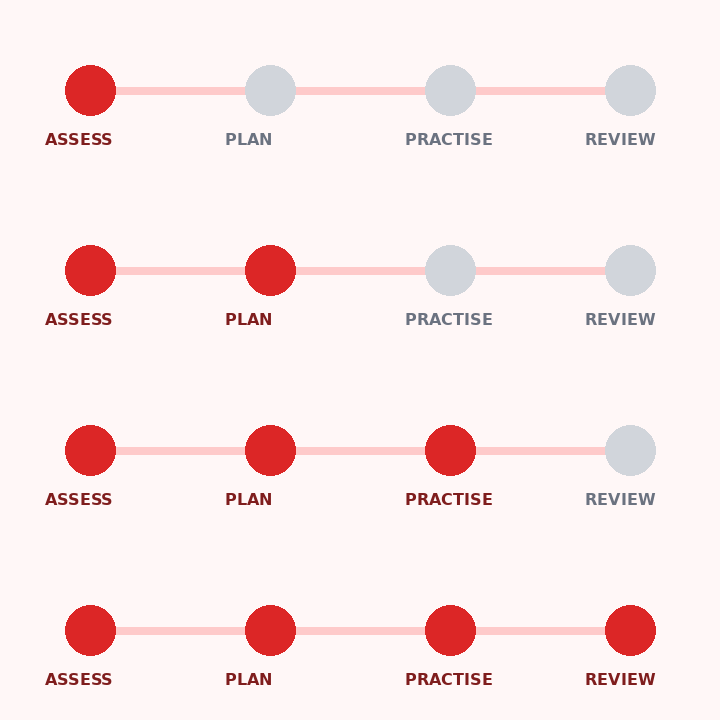
A long note can still hide the clinical decision. A short note can still be useful if the next clinician can see what changed, what it means and what needs to happen next.
A simple test is this: could another physiotherapist understand why you selected an assessment, continued or changed an intervention, slowed progression, referred, transitioned or ended care? If not, the record may contain data without showing clinical reasoning.
Documentation is not a session transcript
The World Physiotherapy guideline on documentation and records management treats records as part of professional practice: information should be accurate, sufficiently complete, legible, dated, authenticated and protected from unauthorised access. Relevant records should show assessment, plan, intervention, response, re-evaluation, important communication and closure of care.
A note is therefore not a copy of every sentence spoken or every movement performed. It is a professional summary connecting information → interpretation → decision → follow-up.
Five steps that make reasoning visible
- Collect relevant information: the person’s story, goals, symptoms, function, context, measures and response to previous care.
- Frame the problem: distinguish impairment, activity limitation, participation restriction and environmental factors.
- Generate and test hypotheses: state the most plausible explanation, supporting findings, discordant findings and risks that still need screening.
- Choose action with the person: connect intervention to individual goals and preferences, suitable evidence, resources and the real setting.
- Reassess: compare change with baseline, then continue, modify, refer, transition or discharge with a clear reason.
The original paper by Edwards and colleagues on clinical reasoning strategies in physical therapy describes decision making as more than diagnostic classification. It also includes procedural, interactive, narrative, teaching, collaborative and predictive reasoning. The Physiopedia Clinical Reasoning overview is a useful secondary orientation to the iterative cycle of collecting data, generating hypotheses, testing and reassessing.
Use the ICF to avoid a narrow note
The WHO International Classification of Functioning, Disability and Health (ICF) provides a language for considering body functions and structures, activities, participation and environmental factors. A diagnosis alone does not explain how someone moves, works, cares for family or participates in life.
For example, “reduced quadriceps strength” is an impairment finding. The note becomes more useful when it also identifies the affected task, such as rising from a low chair, the participation consequence, and environmental factors such as stairs or the absence of a handrail. That connection keeps goals and outcome measures relevant.
SOAP: a structure, not a shortcut
SOAP is one of several documentation formats. The Physiopedia SOAP Notes overview separates Subjective, Objective, Assessment and Plan. Its value comes from keeping each section’s job distinct, not from the four letters themselves.
S — reported information
Record what the person or caregiver reports: symptoms, function, response after the last session, concerns, goals and contextual change. Separate their report from your observation. Use quotation marks only when the exact wording matters.
O — observed or measured information
Include observation, tests, outcome measures, intervention dosage, assistance, equipment, education and response during the session. “Exercises completed” is too general for continuity. Record the task, assistance, dose or measure that informed the decision.
A — professional interpretation
Assessment is not the place for “improving” without a basis. Explain what the change means: hypotheses strengthened or weakened, factors limiting progress, connections between findings and goals, risk, and why the plan is maintained or modified.
P — the next action
State specific next steps: progression, regression, reassessment, measures to repeat, education, coordination, referral, proposed frequency and safety-netting. “Continue treatment” does not tell the clinician or patient what should happen.
Patient is better. Exercises completed. Continue treatment.
The patient reports easier stairs but still stops after one flight. Sit-to-stand increased from 7 to 9 repetitions with stable technique. This supports improved loading tolerance, although stair endurance still limits work return. Continue progressive loading, add graded step-ups, repeat the measure next week and review the 24-hour symptom response.
Document uncertainty instead of hiding it
Clinical reasoning rarely begins with complete certainty. A safe record can say “working hypothesis”, “more consistent with”, “less likely because”, “requires monitoring” or “insufficient data”. This is more transparent than an absolute conclusion that the findings do not yet support.
Record what would change the decision: a new symptom, sudden deterioration, neurological finding, altered tolerance, missed milestone or unexpected response. If the issue is beyond competence, setting or platform pathway, document the escalation and communication completed.
Shared decisions should still be visible
The NICE shared decision making guidance describes professionals and individuals working together, using evidence alongside the person’s preferences, beliefs and values. In the note, show the options discussed, what matters to the person, consent or refusal, and the selected plan. Avoid labelling a person “non-compliant” without describing barriers, understanding or choice.
Fictional scenario: from data to decision
- S: mild pain after 15 minutes standing, low confidence on stairs, home practice completed on four days, no numbness or sudden deterioration.
- O: weight-bearing dorsiflexion remains limited versus the other side, single-leg balance 12 seconds with hip strategy, step-down requires light support, swelling reduced.
- A: loading tolerance is improving, while ankle mobility and single-leg control still limit stairs and work demands. Current response supports graded progression; continue monitoring night pain, swelling and neurological change.
- P: progress dorsiflexion and calf loading, practise step-downs with technique criteria, repeat a functional measure next session, agree a graded increase in standing time and escalate if symptoms increase unexpectedly.
Check before signing the note
- Is it clear who reported the information and what you observed?
- Are findings linked to activity, participation or a meaningful goal?
- Does the interpretation explain why the decision was made?
- Are uncertainty, risk and monitoring points stated?
- Is the plan specific enough for the next action?
- Are shared decisions, consent, important communication and referrals recorded?
- Is the note dated, authenticated, professional, minimal but sufficient, and protected according to organisational requirements?
Sources and further reading
- World Physiotherapy: Guideline for physical therapy documentation and records management
- World Physiotherapy: Guideline for standards of physiotherapist practice
- World Physiotherapy: Ethical principles and responsibilities
- World Health Organization: International Classification of Functioning, Disability and Health (ICF)
- Edwards et al.: Clinical reasoning strategies in physical therapy
- NICE: Shared decision making recommendations
- Ministry of Health Malaysia: Allied Health Professions Act 2016 (Act 774)
- Physiopedia: Clinical Reasoning · Physiopedia: SOAP Notes
This professional education article is not individual clinical or legal advice and has not been presented as a named clinician review. Applicable Malaysian law, professional standards, organisational requirements, platform protocols and case-specific clinical judgement prevail.
Share this article
Share a practical way to make assessment, interpretation and next steps visible in clinical records.