
Physiomobile Partner Learning
Clinical Reasoning During a Physiotherapy House Call
A practical real-time reasoning flow for physiotherapy house calls: screen risk, understand function in context, test a working hypothesis, reassess and choose the next decision.
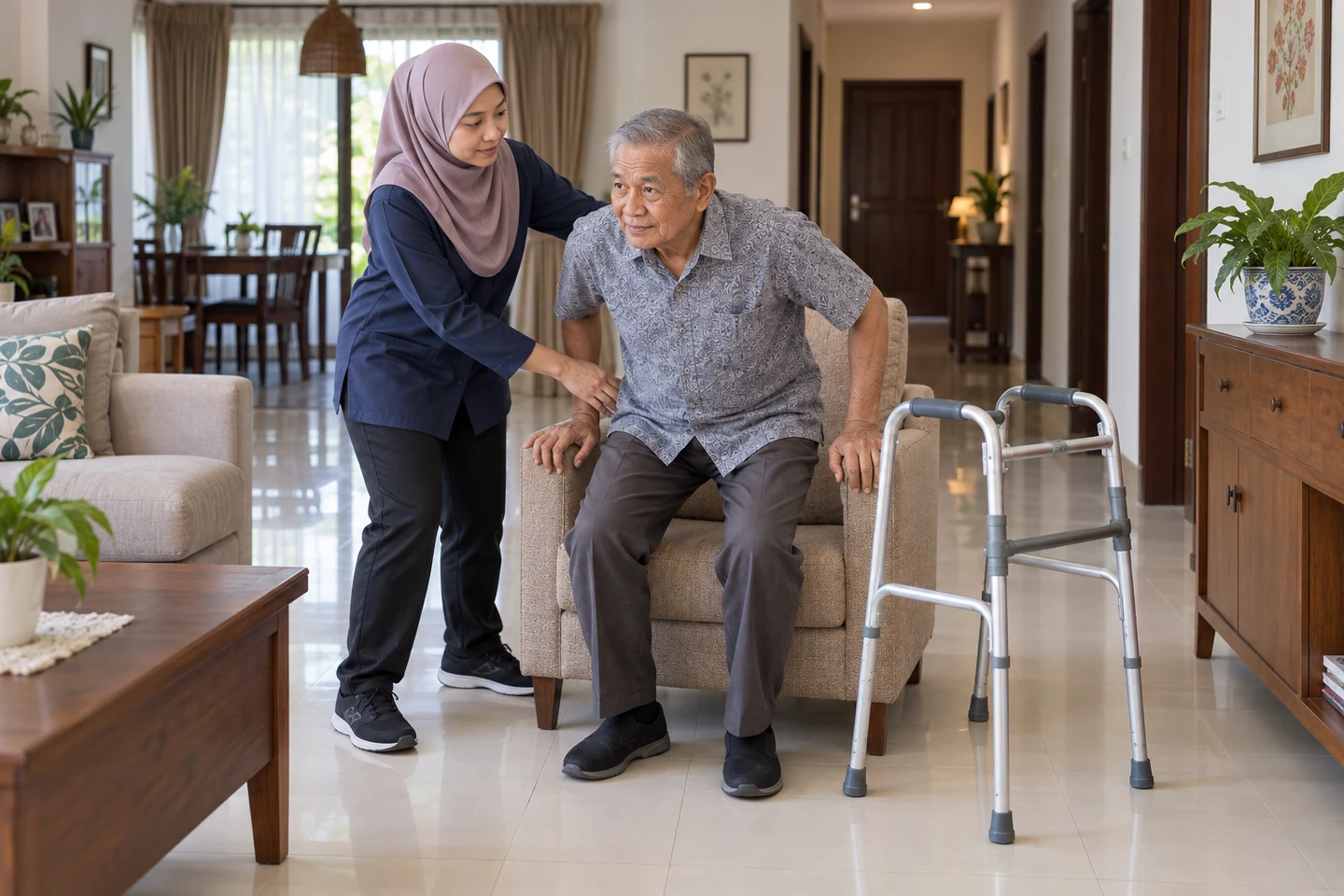
AI-generated editorial image; it does not depict actual people, a real home visit or a patient outcome.
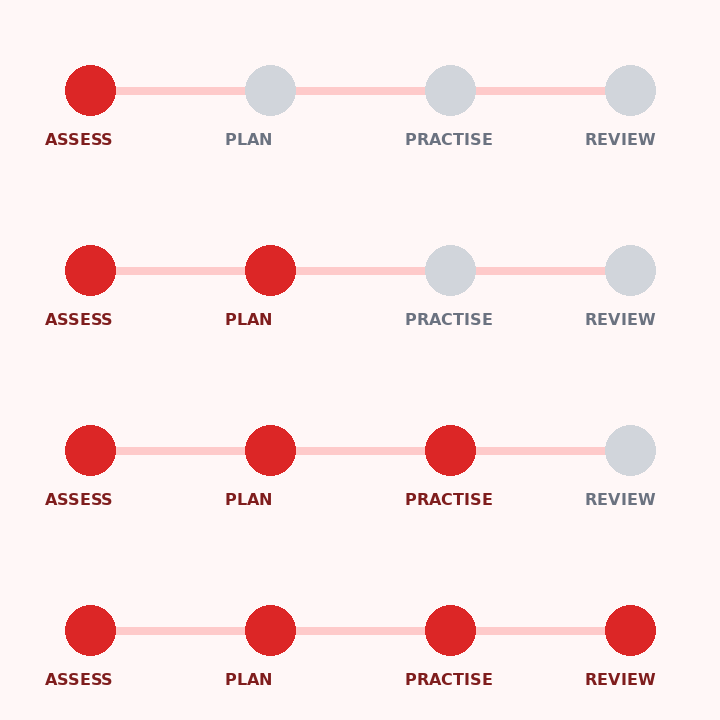
A house call is not a clinic session simply moved into a living room. During one visit, a physiotherapist must interpret the person’s presentation, the real task they need to perform, the environment, the response to intervention and the level of risk—then choose a next step while information is still developing.
Real-time clinical reasoning can be expressed as a loop: predict → observe → test → reassess → decide. The flow below is not a generic checklist for every condition. It is a way to make decisions within one visit more structured, transparent and responsive to the home context.
1. Before arrival: define the question the visit must answer
Review the referral question, the person’s priority, recent change, known diagnoses, relevant comorbidities and medicines, precautions, communication needs and the decision required from the visit. Confirm that the service is within your competence and scope. The World Physiotherapy standards of practice guideline covers competence, assessment, risk management and referral when needed. Malaysian registration and practising-certificate context can be checked in the Allied Health Professions Act 2016 (Act 774) and through the Malaysian Health Care Practitioners System.
Plan for lone-worker risk as well: confirm the address and access, who will be present, pets, stairs, infection concerns, equipment and whether a second worker is required. HSE guidance on risk assessment before a home visit and training, supervising and monitoring lone workers supports a clear itinerary, check-in, communication and escalation arrangement. If foreseeable risk cannot be adequately controlled, entering the home is not a clinical obligation.
2. On arrival: identify, obtain consent and pause
Introduce yourself, verify the patient and explain the visit’s purpose and likely flow before assessment or treatment. Obtain valid, ongoing consent. The World Physiotherapy ethical principles place the patient at the centre of decisions, while its standards of physiotherapist practice guideline covers consent, confidentiality, assessment, risk management, referral and reassessment.
A family member’s presence does not equal the patient’s permission to disclose information. Ask whether the patient wants them present, which role is acceptable and when a private conversation is needed. Seek separate permission before photography, video or information sharing. Malaysia’s personal data protection principles support collecting what is needed, stating the purpose, limiting disclosure and safeguarding information.
Before opening the treatment bag, scan the person and setting: distress, material change, lighting, surfaces, movement space, people or animals, furniture and your own exit route. New information at the door may change the entire plan.
3. Screen first, then assess
Begin with two questions: “What has changed?” and “What do you most need to do today?” Screen urgent medical or neurological concerns before routine testing. NICE NG59 advises reconsidering alternative diagnoses when symptoms are new or changed, and NICE NG127 gives examples requiring immediate referral, including rapidly progressive symmetrical limb weakness or cauda-equina-pattern symptoms involving bladder, bowel, sexual function or perineal sensation.
If there is an immediate threat to life, stop physiotherapy and activate the local emergency pathway. A Malaysia MOH clinical reference on the emergency stroke pathway states that the public can call 999 to connect to the pre-hospital care system. These examples are not an exhaustive red-flag screen; use condition-specific screening and clinical judgement.
Once immediate risk is addressed, choose only tests that could change the working hypothesis, risk decision, treatment, referral or follow-up. More testing does not automatically produce a better decision.
4. Build an ICF-informed problem profile
Organise findings across the health condition and body functions or structures; activities; participation; environmental factors; and relevant personal factors. The WHO International Classification of Functioning, Disability and Health (ICF) helps connect body findings with what a person does in the context of their life.
The home lets you compare capacity during testing with performance in the real setting. A person may show adequate strength while seated yet remain unable to reach the toilet at night because of a narrow path, low lighting, urgency, walking-aid placement or fear of falling. Environmental observation refines the clinical examination; it does not replace it.
5. State the working hypothesis and shared plan
Before intervening, state to yourself: the leading explanation; competing explanations or red flags not yet excluded; modifiable impairments, task constraints and environmental barriers; the patient’s priority; and the response that would strengthen or weaken the hypothesis. The Physiopedia Clinical Reasoning overview can serve as secondary orientation to hypothesis generation and testing, but professional and primary sources should anchor practice claims.
Explain the options, expected benefits and risks, alternatives and the option not to proceed. The agreed plan may differ from what you imagined before arrival—and that change can indicate better reasoning, not poor preparation.
6. Use intervention as a clinical test
Select the smallest safe, meaningful intervention that can test the hypothesis: cueing, task modification, graded activity, exercise, positioning, an equipment or environmental change, caregiver training or education. Decide in advance what response you expect.
During the task, monitor symptoms, movement quality, confidence, assistance and safety. Modify or stop if the response conflicts with expectations, risk increases, consent is withdrawn or the home cannot support safe practice. An intervention is not only something delivered; the response to it is new clinical information.
7. Reassess and decide
Repeat the measure or task most relevant to the decision—not the whole assessment. Ask what changed immediately, whether function, symptoms, confidence, assistance or safety changed, and whether the patient or caregiver can reproduce the plan correctly. Then ask whether the response strengthens the hypothesis, weakens it or opens another explanation.
- Continue
The expected response occurred and risk is controlled. - Modify
The dose, cue, task or context needs adjustment. - Refer
The need is outside scope or requires other input. - Escalate
Risk or deterioration requires urgent action. - Discharge
The episode goal is met or physiotherapy is no longer suitable.
8. Close the visit safely
Use plain language, demonstration and teach-back to confirm understanding. Give condition-appropriate stopping rules and warning signs, who to contact, the agreed caregiver role and when review will occur. Do not present a generic red-flag list as exhaustive.
Leave the person in a safe position with essential equipment and communication within reach, and check that an equipment change has not created a new hazard. Closing the visit is a clinical decision, not merely packing up.
9. After the visit: make the reasoning traceable
Complete the record during or as soon as possible after the visit. The World Physiotherapy records management guideline supports accurate, objective, dated, attributable and secure records. Document consent, relevant history and findings, assessment and hypothesis, goals, intervention and dose, education, response and reassessment, risks, communications or referrals, and follow-up.
Complete the lone-worker check-out and report hazards or incidents through the organisational process. A note that only lists exercises does not show why the next decision was made.
Fictional scenario: strength is not the whole answer
Before arrival, the physiotherapist expects lower-limb weakness may contribute but also plans to review symptom change, the bathroom route and family support. On arrival, she obtains Mr Rahman’s consent and confirms that his daughter may help with demonstration only, rather than answer for him.
Screening identifies no reported acute change, so a focused assessment proceeds. Mr Rahman rises from a chair and walks a short distance with reasonable control in a well-lit space. The actual night route, however, includes a small table, a distant light switch, a walking aid placed on the other side of the bed and urgency that makes him rush.
The ICF profile and working hypothesis point to an interaction between confidence, the sit-to-stand strategy, urgency and the environment—not strength alone. With his agreement, a small intervention is used as a test: place the walking aid within reach, use the available pathway lighting and practise a rise-pause-walk sequence on the real route. Reassessment provides information about assistance, movement quality and confidence; it does not “prove” one diagnosis.
Decision: modify the plan to combine functional and environmental practice, give the family an agreed role, and review whether the strategy can be reproduced safely. If screening or response had shown unexpected deterioration, the decision should instead move towards referral or escalation.
- What did I expect before testing?
- What actually happened?
- Did the response support my hypothesis?
- Which risks or alternative explanations remain open?
- What is the next decision, and could another clinician understand its reason from my record?
Sources and further reading
- Ministry of Health Malaysia: Allied Health Professions Act 2016 (Act 774)
- Malaysian Health Care Practitioners System: About registration and practising certificates
- World Physiotherapy: Standards of physiotherapist practice guideline
- World Physiotherapy: Ethical principles and responsibilities
- World Physiotherapy: Records management guideline
- World Health Organization: International Classification of Functioning, Disability and Health
- UK Health and Safety Executive: Managing risk before home visits · Training, supervision and monitoring for lone workers
- Malaysia Personal Data Protection: Principles of personal data protection
- NICE NG59: Low back pain and sciatica recommendations · NICE NG127: Suspected neurological conditions
- Ministry of Health Malaysia: Quick Reference for Management of Anterior Circulation Ischaemic Stroke
- Physiopedia: Clinical Reasoning (secondary orientation)
This professional education article is not individual clinical or legal advice and has not been presented as a named clinician review. Case-specific judgement, applicable Malaysian law and professional standards, employer or platform procedures, and local emergency pathways prevail.
Share this article
Share a practical way to reason from arrival through reassessment and the next decision.