
Physiomobile Partner Learning
Continue, Modify, or Discharge? A Reassessment Guide for Physiotherapists
A practical reassessment framework for deciding whether skilled physiotherapy should continue, change, transition or end—using shared goals, serial measures, risk and clinical reasoning.

AI-generated editorial image; it does not depict actual people, a real reassessment or a patient outcome.
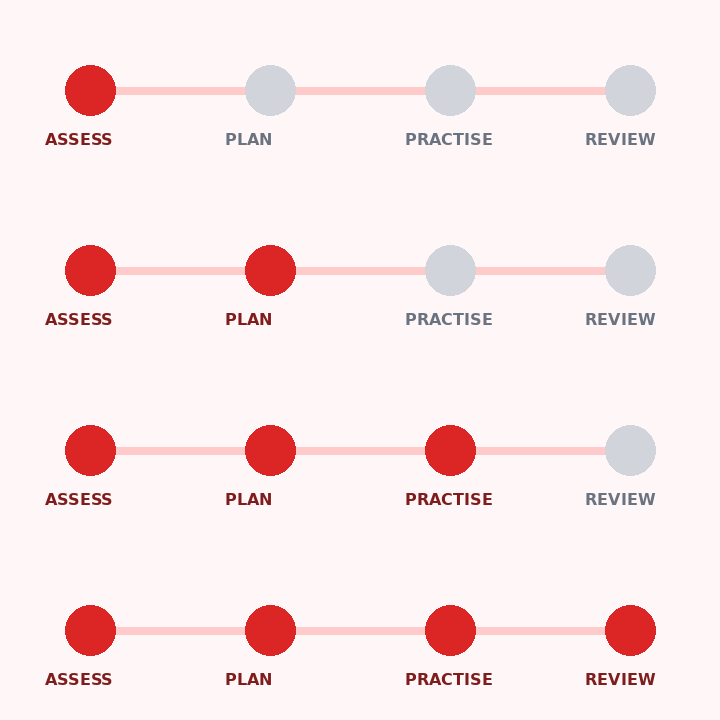
Reassessment is not simply repeating the initial assessment or asking whether pain has reduced. It is a decision point: is the current plan still safe, meaningful and dependent on physiotherapy skill, or should the direction of care change?
A sound decision does not depend on one score or one session. It integrates symptoms, function, response to the plan, risk, the patient’s goals and preferences, and whether the working diagnosis or hypothesis still makes sense. The World Physiotherapy standards of practice guideline connects reassessment with monitoring change, managing risk, referral and decisions to continue, modify or end care.
What should reassessment review?
A focused reassessment compares the current position with baseline and the plan’s expectations. Review information that could change the decision:
- Symptoms and signs: pattern, irritability, stability, new change or unexpected deterioration.
- Function and participation: the real task, assistance, confidence, tolerance, safety and involvement in valued roles.
- Response: what occurred after intervention, self-management, dose changes or time.
- Risk: red flags, adverse effects, falls risk, environmental factors, caregiver burden or barriers to safe delivery.
- Goals and priorities: whether they remain relevant, realistic and mutually agreed.
- Working diagnosis or hypothesis: whether findings strengthen it, weaken it or create new uncertainty.
Use appropriate, consistently applied serial outcome measures when they can help. The World Physiotherapy standard supports monitoring change and functional outcomes, while Shared decision making and physical therapy: What, when, how, and why? describes discussing options, benefits, harms and uncertainty alongside the patient’s values and preferences. Measures and goals inform decisions; they do not dictate them or replace clinical reasoning.
A plateau is not an automatic discharge instruction
Slow change or a plateau should prompt reassessment: is the measure sensitive enough, is the goal appropriate, is the dose feasible, does the working diagnosis still hold, can barriers be modified, or is another approach needed? The qualitative study Discharge from Outpatient Orthopaedic Physiotherapy describes how physiotherapists in one outpatient context distinguished temporary plateaus from maximum function and considered adjustment, referral or discharge. That setting-specific finding informs reasoning; it is not a universal algorithm.
A plateau is a prompt to reassess, not an automatic discharge rule. Nor does it automatically justify indefinite continuation. The central question is whether skilled physiotherapy is still reasonably expected to add meaningful benefit, and whether a different or safer pathway is more suitable.
Three principal decisions
Continue
Continue when there is a reasonable direction towards improvement, maintenance or prevention and physiotherapy skill remains necessary for assessment, progression, dosing, education, adaptation, risk monitoring or coordination.
Modify
Modify when the hypothesis, dose, task, method, frequency, context or support should change. Use a time-limited trial with a specific change, measure, review criteria and decision date defined in advance.
Discharge or transition
Plan collaboratively when episode goals are met, self-management is safe, the informed patient chooses to stop, no further benefit is expected from the current skilled plan, or another provider is more suitable.
Discharge does not require a person to be entirely pain-free. Instead, consider function, risk, understanding, capacity to carry out the plan and the clinical reason for skilled input. The College of Physiotherapists of Ontario assessment, diagnosis and treatment standard describes evaluating outcomes and discharging or discontinuing when care is no longer required or effective; applicable local standards and context still prevail.
Practical decision flow
- Check safety first. If there is unexpected deterioration, material diagnostic uncertainty, a need outside scope or competence, or risk that cannot be controlled, leave the routine pathway and refer or escalate.
- Ask what matters now. Confirm goals, priorities, experience of the plan and patient preference. The AHRQ IDEAL framework emphasises involving the patient and identified family in transition planning.
- Compare with baseline. Use symptoms, the functional task, assistance, confidence, tolerance, safety and relevant outcome measures—not one isolated score.
- Explain the response. Decide whether improvement, lack of change or deterioration fits the working hypothesis. Review adherence without blame, barriers, dose, timing, comorbidity and context.
- Test the indication for skilled input. State the work that still requires physiotherapy skill and the benefit reasonably expected from it.
- Choose and agree the pathway. Continue, modify through a time-limited trial, or discharge/transition. Explain options, uncertainty, expected benefits and risks, alternatives and the option not to proceed.
- Set the next review. Record what will be measured, when it will be reviewed and the criteria for continuing, modifying, referring or ending the episode.
If modifying, make the trial evaluable
“Try again” is not a sufficiently clear plan. State the hypothesis being tested; the exact change in intervention, dose, task or context; the measure to repeat; the trial period; the response that supports continuation; and the response that requires referral, another strategy or transition. A time-limited trial reduces directionless treatment and makes the next discussion transparent.
If discharging or transitioning, build a safe close
Transition planning should begin before the final day and be completed with the patient and, with permission, family or other providers. The secondary Physiopedia Discharge Planning and Goal Setting in Rehabilitation pages can offer practical orientation, but professional and primary sources should anchor decisions.
- Current status and change from baseline.
- Needs that remain unresolved.
- An understood home or self-management plan.
- Relevant warning signs and stopping rules.
- Who to contact and how.
- Arranged follow-up, referral or handover.
- Criteria for returning or seeking a new review.
- The agreed caregiver role, where relevant.
The World Physiotherapy ethical principles support respect for autonomy, dignity, consent and honest communication. Transition decisions should be collaborative, including when an informed patient chooses differently from the physiotherapist’s recommendation.
Document the reason, not only the decision
The World Physiotherapy records management guideline supports accurate, objective, contemporaneous, attributable and secure records. Document reassessment findings, comparison with baseline, measures and their limits, the patient’s perspective, risk, current hypothesis, options discussed, the shared decision, review criteria, communication, referrals and the transition plan.
Malaysia’s Allied Health Professions Act 2016 (Act 774) provides regulatory context; it is not a continue-modify-discharge decision algorithm. Apply relevant professional standards, scope, competence, organisational or platform procedures and case-specific judgement.
Fictional learning scenario: progress stalls during a step task
After several sessions, walking tolerance has improved but step performance appears unchanged. Rather than discharge because of a “plateau” or continue the same plan without a boundary, the physiotherapist reassesses: there is no reported new deterioration, but Ms Mira still needs cueing, rushes when tired and has avoided practice because the available home step setup is unstable.
The goal remains important to her. The working hypothesis shifts from “insufficient strength” alone to an interaction between task strategy, confidence, pacing and the practice environment. They agree a time-limited modification trial: use a stable step setup, begin at a lower height, practise foot sequence and pacing, and repeat assistance, task quality, symptoms and confidence at an agreed review date.
At review, three pathways are already defined: continue if the task becomes safer and assistance reduces; modify or refer if another barrier or uncertainty emerges; or transition to self-management/another provider if the current skilled input is no longer expected to add benefit. Unexpected deterioration or a safety concern would trigger referral or escalation rather than waiting for the trial to end.
- What changed in symptoms, function, risk and goals?
- What do the measures explain—and what do they not explain?
- Does the working diagnosis or hypothesis still fit?
- What work still requires physiotherapy skill?
- Does the patient understand the choices, review criteria and transition plan?
- Could another clinician follow the reason for the decision from the record?
Sources and further reading
- World Physiotherapy: Standards of physiotherapist practice guideline
- World Physiotherapy: Ethical principles and responsibilities
- World Physiotherapy: Records management guideline
- Ministry of Health Malaysia: Allied Health Professions Act 2016 (Act 774)
- Shared decision making and physical therapy: What, when, how, and why? (2022)
- Discharge from Outpatient Orthopaedic Physiotherapy: A Qualitative Descriptive Study of Physiotherapists’ Practices (2010)
- AHRQ: IDEAL Discharge Planning strategy
- College of Physiotherapists of Ontario: Assessment, Diagnosis, Treatment Standard
- Physiopedia: Discharge Planning (secondary orientation)
- Physiopedia: Goal Setting in Rehabilitation (secondary orientation)
This professional education article is not individual clinical or legal advice and has not been presented as a named clinician review. Case-specific judgement, applicable Malaysian law and professional standards, employer or platform procedures, and local referral and emergency pathways prevail.
Share this article
Share a practical reassessment flow for continuing, modifying or transitioning physiotherapy care.