
Physiomobile Partner Learning
How to Set Measurable Treatment Goals with Patients
A practical physiotherapy workflow for turning patient priorities into function-focused, measurable goals with a baseline, review plan and shared decisions.

Original editorial illustration; it does not depict a real patient, clinician or clinical encounter.
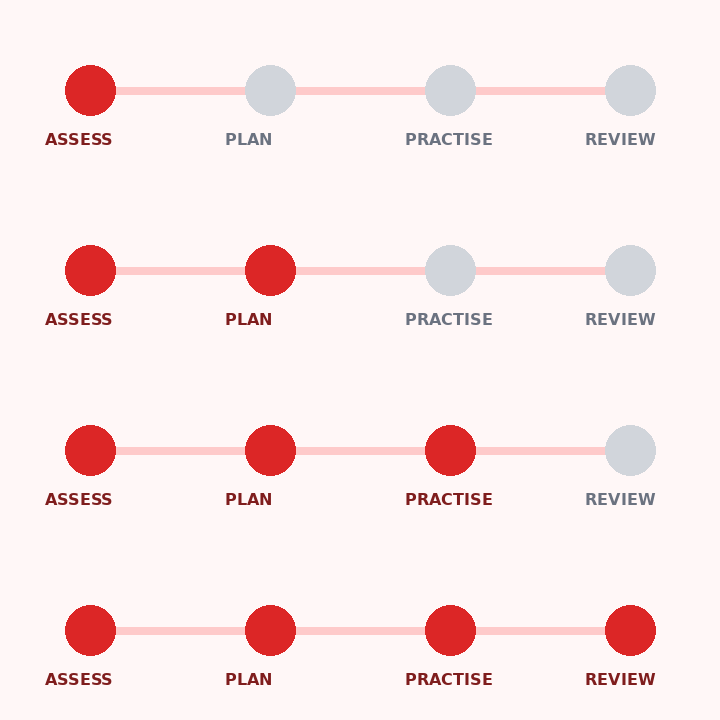
A useful treatment goal starts with a simple question: “What activity does the patient want or need to do better?” In the Malaysian physiotherapy context, Hospital Kuala Lumpur states that services should respond to individual needs, values and preferences. This supports discussing goals together rather than relying only on the physiotherapist’s assumptions.[1]
Shared goals do not mean handing every clinical decision to the patient. Shared decision-making combines the best available evidence, clinical expertise, the available options, benefits and harms, and the patient’s values, preferences and personal circumstances.[2]
Start with the patient’s priority, then translate it into function
The WHO ICF describes functioning across health-related domains and environmental factors. A goal can therefore connect impairment findings to meaningful activity and participation rather than stopping at a body measure alone.[3]
Priority
“I want to pray standing again,” “I want to manage the stairs to my room,” or “I want to return to work without needing frequent rests.”
Observed function
Choose a real task that can be observed: sit-to-stand, walking distance, assistance level, step height, standing time or work tolerance.
Measure and review
Record the baseline, target, test conditions, timeframe and when the decision will be reviewed together.
A seven-step workflow
- Ask what matters. Invite the patient to describe the activity, role or situation they want to improve and why it matters.
- Explain choices and limits. Discuss reasonable options, uncertainty, treatment burden and what may or may not be modifiable. This is part of shared decision-making.[2]
- Select the target function. Link the goal to activity or participation while using impairment findings to explain barriers and select interventions.[3]
- Take a baseline. Record current performance in a repeatable way: task, assistance, distance, time, repetitions, quality, relevant symptoms and context.
- Define an observable change. State who will do what, under which conditions, to what level and by when.
- Agree the plan. State the patient’s, physiotherapist’s and relevant caregiver’s actions, including barriers that need attention.
- Set the review date. Repeat the same measure, discuss what the change means and continue, modify, refer or transition according to the findings and current priorities.
Example: from vague to evaluable
Avoid
“Reduce knee pain.” Pain ratings may be useful, but this goal does not define function, baseline, target or time.
Clearer
“Within four weeks, the patient wants to climb the 12 stairs at home using the handrail, without physical assistance, with no more than one rest.”
Baseline
Today: six stairs, handrail, minimum touch assistance and two rests. Repeat under the same conditions at review.
This is a learning format, not a universal prescription. The real target should account for the working diagnosis, safety, prognosis, capacity, environment, resources and patient preference. The ICF framework helps keep individual function connected to context.[3]
Do not make pain score the only goal
A pain rating can be one data point, but it does not by itself show whether someone can walk to the bathroom, carry a child, work, sleep, exercise or manage self-care. Use symptoms alongside relevant functional measures and the patient’s account of how the condition affects daily life.[3]
Do not promise that a particular goal-setting method will produce better physical outcomes. A Cochrane review of adult rehabilitation found uncertain, low- or very-low-quality evidence for many outcomes; goals are a tool for organising care and discussion, not a guarantee of results.[4]
Review is more than “achieved” or “not achieved”
At review, compare the measure with baseline, confirm whether the goal still matters and discuss what helped or obstructed progress. If the target was not met, do not automatically blame the patient or repeat the same plan. Revisit the measure, dose, barriers, working hypothesis, risk, timeframe and target through a shared discussion.[2]
- The patient’s priority and why it matters.
- The functional task and test conditions.
- A repeatable baseline.
- The agreed target and timeframe.
- Each party’s plan and identified barriers.
- The review date, measure and criteria.
- The review decision and reason to continue, modify, refer or transition.
A measurable goal is more than a SMART sentence in the record. It is a working agreement connecting what matters to the patient, observable function, a reasonable plan and a transparent next decision.[1][2]
References
- Malaysia, Ministry of Health: Hospital Kuala Lumpur Physiotherapy Department — local context on responsiveness to individual needs, values and preferences.
- Shared decision making and physical therapy: What, when, how, and why? (2022).
- WHO: International Classification of Functioning, Disability and Health (ICF).
- Cochrane Review: Goal setting and strategies to enhance goal pursuit for adults with acquired disability participating in rehabilitation.
This professional education article is not individual clinical advice. Apply case-specific judgement, safety screening, professional scope, applicable Malaysian requirements and local referral pathways.
Share this article
Share a practical workflow for setting functional, measurable treatment goals with patients.