
Physiomobile Partner Learning
Caring for Older People at Home: Falls, Environment and Caregivers
A practical, person-centred framework for multifactorial falls assessment, safer home mobility, caregiver communication, referral boundaries and escalation.
Original editorial illustration; it does not depict real people, a real home assessment or a guaranteed outcome.
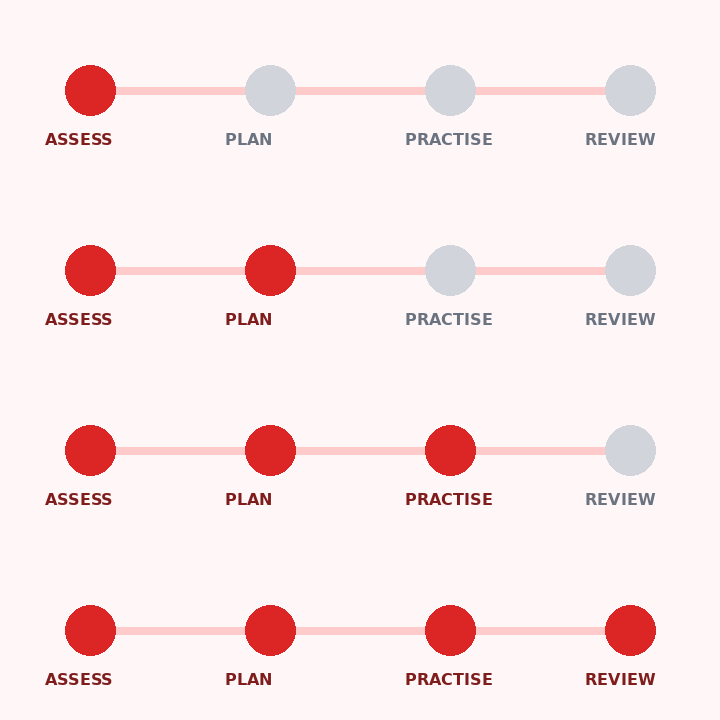
Falls risk is not one problem with one solution. A comprehensive assessment considers fall history, gait, balance, mobility, strength, blood pressure, dizziness, cognition, vision, hearing, feet and footwear, medicines, continence and daily function.[3]
Malaysia’s Ministry of Health (MOH) leaflet also identifies leg weakness, impaired balance or coordination, vision, medicines, slippery floors, lighting and route obstructions as factors that deserve attention.[1]
1. Start with a multifactorial assessment
Ask what happened before, during and after a fall or near-fall; review functional change, symptoms, confidence, assistive devices and activities that matter to the person. Identified factors should lead to an appropriate action or referral, not a blanket list of restrictions.[3]
Function and movement
- Gait, balance, transfers and mobility.
- Strength and control during real tasks.
- Footwear, feet and assistive devices.
These components align with the NICE England comprehensive falls assessment.[3]
Medical and sensory factors
- Dizziness, blood pressure, cognition and neurological conditions.
- Medicines, vision, hearing and continence.
- Bone health and concern about falling.
Physiotherapists screen within scope and refer when an issue needs a doctor, pharmacist, optometrist or ophthalmologist.[3]
2. The environment is part of the task
Malaysia’s MOH advises good lighting, non-slippery floors, stair handrails and uncluttered routes. A home assessment should examine how the person actually reaches the toilet, bedroom, prayer space, kitchen and exit, rather than treating the home as a generic checklist.[1]
NICE England recommends home-hazard assessment and intervention using a validated tool and considering an occupational therapist or appropriately trained staff with suitable supervision. This is England guidance, not Malaysian law or a Malaysian protocol.[3]
3. Medicines and vision: identify, do not take over
A structured medication review can identify medicines that increase falls risk and whether adjustment should be considered. Caregivers and physiotherapists should not independently stop, reduce or switch medicines; concerns belong with the treating doctor or pharmacist.[3]
Malaysia’s MOH advises an eye examination for blurred vision and regular medical review including an eye doctor. NICE England also states that visual impairment caused by cataracts warrants ophthalmology referral.[1][3]
4. Mobility and strength without prevention promises
Falls-prevention exercise should be progressive, tailored to the person’s needs, preferences, goals and abilities, and address balance, coordination, strength and power. It is not one exercise prescription for every older person.[3]
Malaysia’s MOH resistance-band guide describes gradual progression and instructs the person to stop if pain occurs. This supports assessed and monitored dosage, not a promise that any exercise will prevent every fall.[2]
5. Caregivers support rather than replace autonomy
Home care should centre on the older person’s aspirations, goals and priorities and maintain independence by focusing on what the person can and wants to do. Ask whether the person wants a caregiver involved in planning and respect that choice.[4]
Practical communication can agree the assistance offered, consistent cues, equipment use, how to obtain help after a fall, and health changes that should be recorded and escalated. Family or caregiver education should be included when appropriate, not automatically without the person’s agreement.[3][4]
6. After a fall: escalation boundaries
Repeated falls, declining mobility, neurological change, fainting, pain or suspected injury require further assessment with urgency matched to the findings and scope of practice. This is not an exhaustive list, and this article does not replace individual clinical assessment.[3][5]
References
- [1] Ministry of Health Malaysia: Falls leaflet for older people (Malaysia; falls factors, eye review and home safety)
- [2] Ministry of Health Malaysia: Resistance-band exercise for older people (Malaysia; progressive resistance and stopping for pain)
- [3] NICE NG249: Falls assessment and prevention (England comparator; multifactorial assessment, referral, home hazards and exercise)
- [4] NICE NG21: Home care recommendations (England comparator; autonomy, independence and caregiver involvement)
- [5] NHS: Falls (England comparator; immediate action after a fall)
This professional education article is not individual medical advice. Foreign guidance is labelled by jurisdiction and is not Malaysian law. Current Malaysian professional standards, organisational procedures, local referral and emergency pathways, and case-specific clinical judgement prevail.